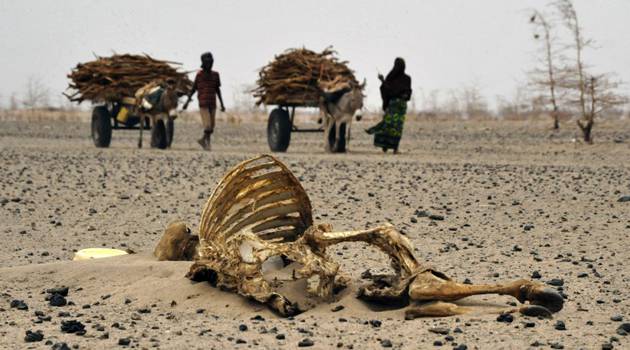
Millions of Kenyans are grappling with hunger and nutrition shortages as drought continues to devastate 23 counties, with children and mothers most affected, Public Service Cabinet Secretary Geoffrey Ruku has reported.
The crisis now touches 3.3 million people, including 810,000 children under five and 104,000 pregnant and breastfeeding women.
In an interview with Citizen TV on Thursday, Ruku explained the scale of the problem and the government’s response.
“We have a huge number of children who are affected from the age of six months to 59 months. We have about 810,000 children who are affected, and women who are pregnant and lactating who are affected in these counties, we have about 104,000 women who are affected. This is a huge number, and the government is doing all it can,” he said.
The government is collaborating with organizations such as the Red Cross to provide nutrition assistance. Fortified porridge is being distributed, while NACONEK, under the Ministry of Education, runs school feeding programs in drought-affected regions.
Ruku said the Cabinet recently approved an extra Sh2.1 billion to strengthen these efforts.
“At the last cabinet meeting on Tuesday, the government passed more money for NACONEK to ensure all school-going children in areas ravaged by drought get support. This amounts to about Sh2.1 billion. From June to December, we have spent about Sh6 billion putting these programs in place,” he said.
He stressed that the government’s approach addresses multiple needs: food, water, and livelihoods. “For example, in counties like Mandera, Turkana and Wajir, we are giving nutrition support to children and the elderly, who are mostly in pastoral communities,” he added.
The impact of the drought varies by county. Some, including Bungoma and Kiambu, remain largely unaffected. Data from the National Drought Management Authority shows Mandera, Wajir, Kware, and Garissa are in phase four, while Baringo, Kajiado, Samburu, Taita Taveta, Turkana, Tana River, Isiolo, and Marsabit are in the critical arid category.
Resource allocation is based on need, Ruku said.
“In counties classified as severe, households face food consumption gaps. In counties in the critical arid phase, households have almost no food. The government is ensuring food distribution in high supply. For example, from July to February, in Marsabit, 60,000 bags of rice and 40,000 bags of beans have been distributed. In Garissa, 30,000 bags of rice and over 20,000 bags of beans were provided. Comparatively, in Meru County, 7,480 bags of rice and 9,100 bags of beans were distributed, and in Embu, 8,380 bags of rice and 5,820 bags of beans. This shows the government is targeting the most affected areas,” he said.
Water, human food, livestock feed, and nutrition support remain urgent needs. The government is coordinating with the national service, defence, and regional water bodies to deliver resources through county administrations.
Ruku highlighted livestock support as a key priority. “Every community in counties like Mandera, Wajir, Tana River, Isiolo, and Marsabit depends on livestock.
We are distributing hay and feed where the animals are, not just at central points. This program started last week and will continue through the end of March,” he said.
The livestock offtake program has been rolled out to prevent economic losses.
“The Cabinet passed resources to ensure farmers and families do not lose livelihoods due to dying livestock. We started monitoring in July, and now we are beginning the offtake process with the Kenya Meat Commission. We have allocated more than Sh500 million for this month, as part of the Sh4.1 billion approved by Cabinet,” Ruku explained.
These initiatives are part of a broader government strategy to cushion the impact of the ongoing drought on pastoral and arid counties. Ruku said the interventions are guided by accurate data from the National Drought Management Authority, ensuring aid reaches those most in need.































Comments
Sign in with Google to comment, reply, and like comments.
Continue with Google